A real example: $50,000 a year in hourly terms
A standard full-time job is 40 hours a week × 52 weeks = 2,080 hours a year. So a $50,000 salary works out to:
$50,000 ÷ 2,080 = about $24.04 an hour
That also means roughly $962 a week, $1,923 every two weeks, or $4,167 a month before tax. If you get two weeks of paid vacation, you work 2,000 hours for the same pay, so each hour you actually work is worth $25.00. Enter your own salary and hours above.
How it's calculated
Your hourly rate is simply your annual salary divided by the total hours you work in a year:
Hourly = Annual salary ÷ (hours per week × weeks per year)
At a standard 40 hours a week for 52 weeks (2,080 hours), a $60,000 salary works out to about $28.85 an hour. Working more hours for the same salary lowers your real hourly rate — useful to know when weighing a "salaried" job against an hourly one.
Your real hourly rate: count the hours you actually work
The standard 2,080-hour figure assumes exactly 40 hours a week, every week of the year. Very few salaried jobs work like that. The hours you work beyond 40 lower your real rate, and paid time off raises it, because the same pay covers fewer hours:
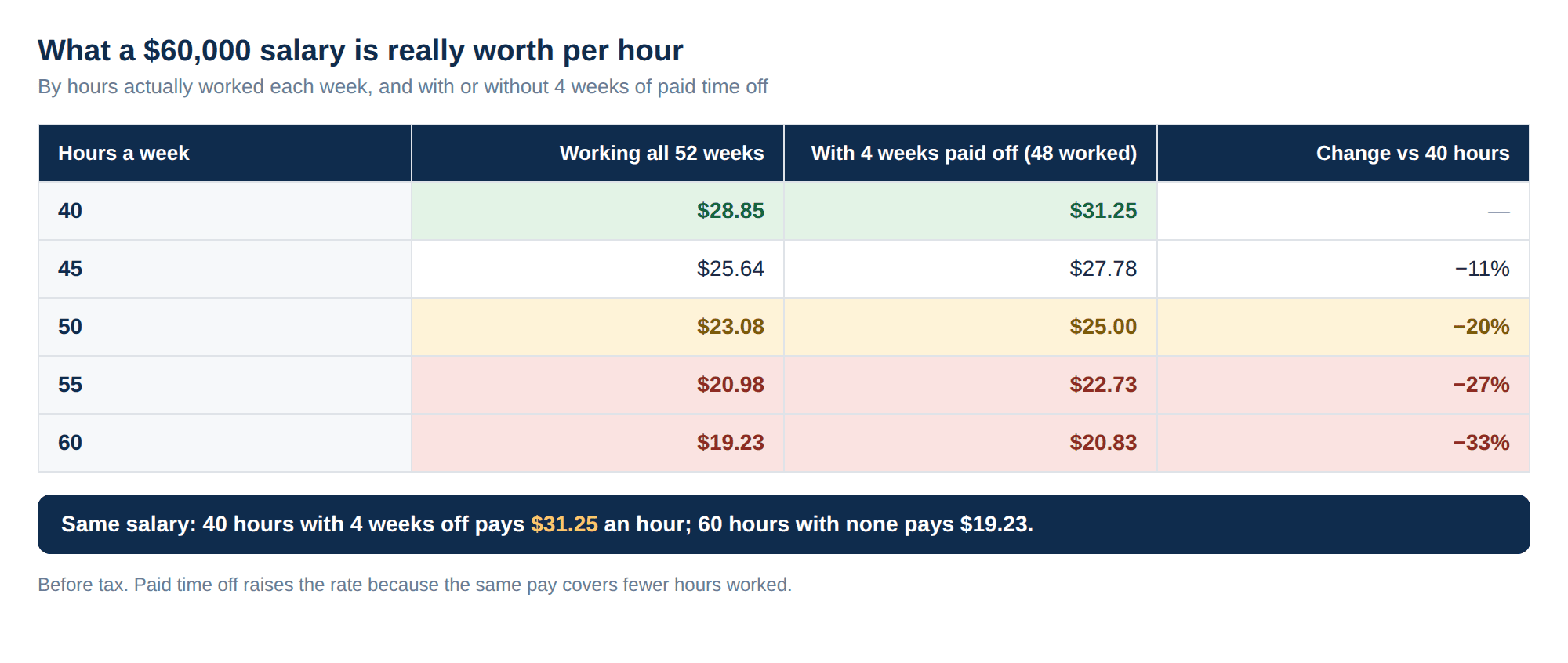
A 50-hour week on a 40-hour salary is a 20% cut per hour; 60 hours is a third. To see your own figure, set the hours slider to what you really work, including the evening emails, and lower the weeks slider by your paid time off. This is the number to compare when you weigh a salaried offer against an hourly one, or two offers with very different hours.
Going the other way: hourly to yearly
If you're paid by the hour and want the annual figure, multiply by the hours you're paid for in a year:
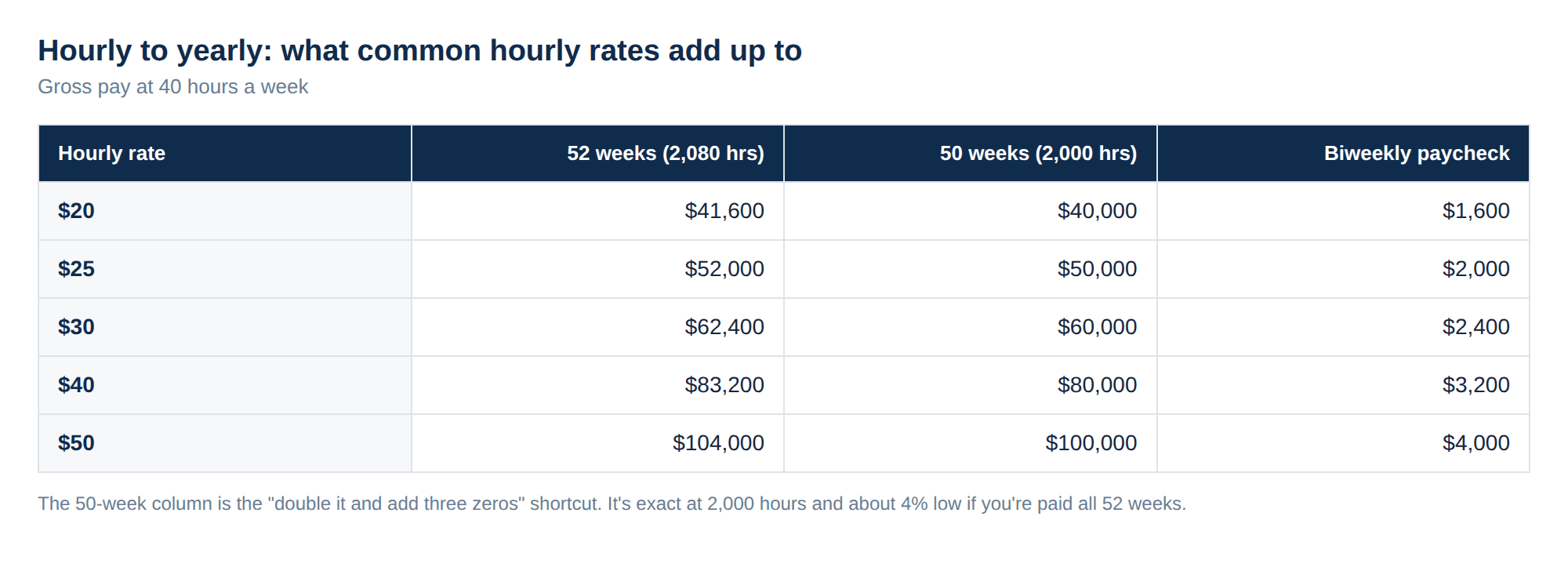
The quick mental shortcut, doubling the hourly rate and adding three zeros, assumes 2,000 hours: 50 weeks of 40 hours. It's a good estimate if you take two weeks unpaid, and slightly low if you're paid for all 52.
Salaried vs hourly — what to watch
- Unpaid overtime quietly cuts your effective hourly pay. A 50-hour week on the same salary is a real pay cut per hour.
- Benefits matter: salaried roles often include paid time off, health insurance and retirement matching that raise total compensation.
- Freelancers: set your rate well above your old hourly wage to cover taxes, gaps between gigs, and your own benefits.
When this calculator can mislead you
- It's before tax. Every figure is gross pay. What reaches your account is lower; see the paycheck calculator and gross vs net pay.
- Overtime pay isn't modelled. Many hourly jobs pay a higher rate for hours over 40, so an hourly worker's 50-hour week can be worth more per hour, not less. The calculator assumes one flat rate.
- Benefits aren't in the number. Health insurance, retirement matching and paid leave can be worth thousands a year, so compare total compensation, not just pay. The 401(k) calculator shows what a match adds up to.
- Biweekly isn't twice a month. Biweekly pay means 26 paychecks a year; semi-monthly means 24. On $60,000 that's $2,307.69 versus $2,500 per check. With biweekly pay, two months a year bring a third paycheck.
- The daily figure assumes a five-day week. On a four-day or six-day schedule, divide the weekly figure by your actual number of days.
- Freelance rates need a bigger cushion. Self-employed pay has to cover both halves of payroll tax, unpaid gaps between clients and your own benefits, so the same hourly number buys much less.
Make your income work harder
Budget your take-home
Knowing your hourly rate is step one — now plan where it goes.
Open budget tool →Frequently asked questions
Is this before or after tax?
Before tax (gross). To see take-home pay, use the paycheck calculator.
How many work hours are in a year?
Full-time is usually counted as 2,080 hours (40 × 52). To see what you earn per hour actually worked, lower the "weeks per year" slider by your paid time off.
How much is $60,000 a year per hour?
About $28.85 an hour, based on 40 hours a week for 52 weeks (2,080 hours), before tax. If you work 50 hours a week it drops to $23.08; with 4 weeks of paid time off at 40 hours it rises to $31.25 per hour worked.
How do I convert an hourly wage to a yearly salary?
Multiply the hourly rate by the hours you are paid for in a year. At 40 hours a week for 52 weeks that is 2,080 hours, so $25 an hour is $52,000. A quick estimate is to double the hourly rate and add three zeros, which assumes 2,000 hours.
Does paid time off change my real hourly rate?
Yes. Your pay stays the same but you work fewer hours, so each hour worked is worth more. A $60,000 salary is $28.85 an hour over 52 weeks but $31.25 per hour worked if 4 of those weeks are paid time off.
What is the difference between biweekly and semi-monthly pay?
Biweekly pay comes every two weeks, 26 paychecks a year. Semi-monthly pay comes twice a month, 24 paychecks a year. On a $60,000 salary that is $2,307.69 versus $2,500 per paycheck before tax.
Should I count my commute or unpaid overtime?
For comparing jobs, count any hours the job takes from you that you are not paid for, such as regular unpaid overtime. Working 45 hours a week on a 40-hour salary cuts your real hourly rate by about 11%, and 50 hours cuts it by 20%.