A real example: saving $20,000 in 3 years
Say you want $20,000 for a house down payment in 3 years. With no interest, you'd need to set aside:
$20,000 ÷ 36 months = about $555 a month
Keep the money in a 4% high-yield savings account and you'd only need about $524 a month — the interest chips in roughly $1,100 toward your goal, so you save less out of your own pocket. Enter your target, timeline and rate above to find your monthly number.
How much should you save each month?
This calculator works backward from your goal. It grows your existing savings forward, then solves for the regular monthly deposit needed to cover the gap, accounting for the interest those deposits will earn along the way.
Your deadline is the biggest lever
People spend a lot of energy hunting for a slightly better savings rate. For a fixed goal, the deadline matters far more. Here's the calculator's default goal, $50,000 with $5,000 already saved, at different deadlines:
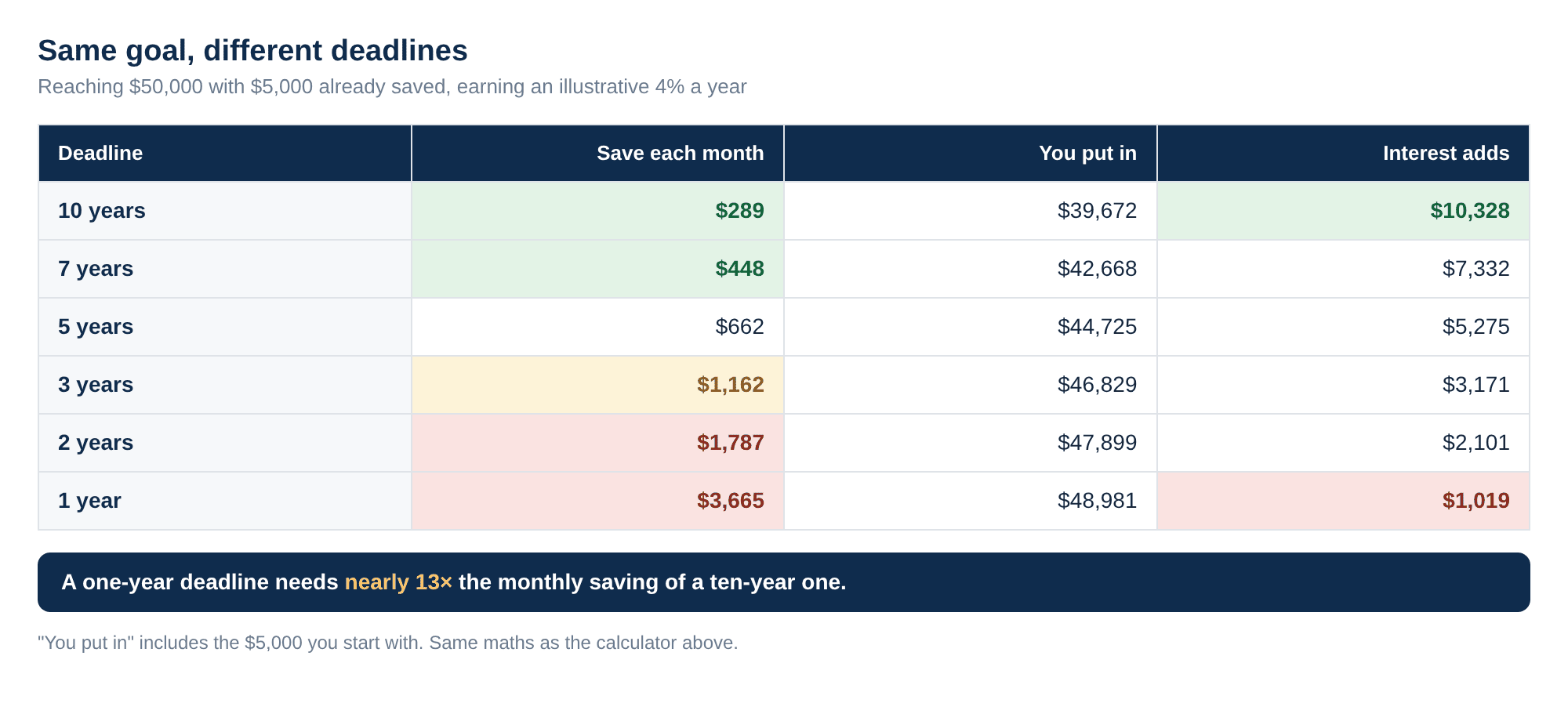
Two things happen as the deadline moves out. You spread the same target over more months, and interest has longer to work: over ten years it contributes $10,328 of the $50,000, over one year just $1,019. If a goal feels out of reach, moving the date is usually the most effective change you can make.
What else moves the number
Your return and your starting balance matter too, just much less than time. Changing one input at a time over a five-year deadline:
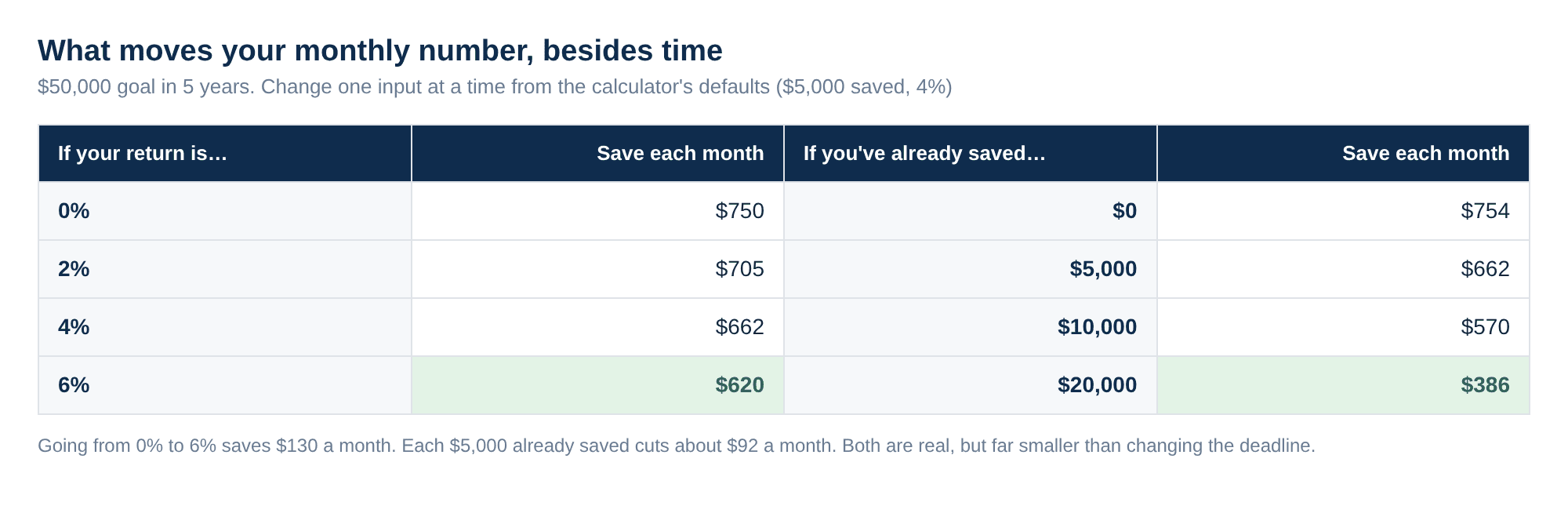
Going from 0% to 6% only saves $130 a month, and for money you'll need within a few years a savings account rate is the realistic input, not an investment return. A head start helps more: each $5,000 you've already put aside cuts about $92 a month off what's left. To see what your current balance earns on its own, use the savings interest calculator.
Match the account to the timeline
- Short-term (0–2 years): use a high-yield savings account or CD — safety matters more than growth.
- Medium-term (3–5 years): a conservative mix; expect modest returns.
- Long-term (5+ years): diversified investments can earn more, with more ups and downs along the way.
When this calculator's answer can mislead you
- Returns aren't guaranteed. A savings account rate can change at any time, and investments can fall right before your deadline. For short-term goals, use a conservative rate. If yours has already slipped, see why savings rates drop.
- Inflation moves the target. The goal is in today's dollars. If you're saving for something whose price rises, like a house deposit or a car, the amount you need at the deadline may be higher. The inflation calculator can estimate it.
- Interest can be taxed. Interest from a savings account is generally taxable, so what you keep can be less than the "interest adds" figure.
- It assumes the same deposit every month. If your income is irregular, aim for the yearly total rather than an identical monthly amount.
- One goal at a time. Saving for several things at once means running each separately, then adding the monthly amounts. Sinking funds are a simple way to keep them apart.
Where to keep your savings
High-yield savings
Online savings accounts often pay many times more than traditional banks.
Compare rates →Automatic transfers
Set up an automatic monthly transfer so your goal funds itself.
Learn how →Frequently asked questions
What if the monthly amount is too high?
Extend your timeline, lower the goal, or increase your starting amount. Small changes to the deadline can make the monthly figure much more manageable.
It says I need $0 per month — why?
Your existing savings, growing at the return you entered, are already projected to reach the goal on their own by your deadline.
How much do I need to save each month to reach $50,000 in 5 years?
With $5,000 already saved and an illustrative 4% annual return, about $662 a month. With nothing saved it is about $754, and at 0% interest with $5,000 saved it is $750. Enter your own figures above.
Does the interest rate make a big difference to my savings goal?
Less than most people expect. For a $50,000 goal over 5 years, moving from 0% to 6% lowers the monthly amount from $750 to $620. Changing the deadline from 5 years to 10 lowers it from $662 to $289.
Should I invest money for a short-term savings goal?
For goals within a few years, most people keep the money in savings, a money market account or CDs, because an investment could fall just before you need it. Longer goals can carry more risk in exchange for potentially higher returns.
Should I adjust my savings goal for inflation?
If you are saving for something whose price tends to rise, such as a home deposit, yes. The calculator uses the goal amount you enter, so raise it to what you expect the cost to be at your deadline.
How do I save for several goals at once?
Run each goal through the calculator separately and add up the monthly amounts. Keeping each one in its own account or sinking fund makes it easier to see progress and avoid borrowing from one goal to pay for another.